On expensive handbags, grocery-store sticker shock, the performance of relatability, and why I no longer feel compelled to make my life sound more ordinary than it is.
I went to the grocery store recently for what I thought was a fairly uneventful list: English muffins, two gallons of milk for my son, two packages of turkey for lunch, and a six-pack of Brooklyn Summer Ale.
The total was $69.
For some reason, I had decided it would be closer to $50, an estimate based on absolutely nothing other than my apparently outdated understanding of what groceries cost.
I paid, went home, and didn’t think much more about it until I realized how objectively ridiculous it was.
I have a handbag collection worth somewhere in the mid-five figures. I could probably tell you what I paid for nearly every bag, which ones were worth the money, which ones have held their value, and which ones I wouldn’t buy again.
Yet there I was, standing at a grocery checkout, wondering when milk and turkey had become so expensive. My relationship with money becomes considerably less logical from there.
I like champagne and Prosecco, and when I stop at an upscale shop in the Village for a bottle, I generally don’t look at the price. I choose what I want and leave.
This doesn’t strike me as particularly unusual until I compare it with my reaction to the grocery bill. Apparently, sparkling wine gets a free pass while turkey requires further investigation.
The Things I Care About, and the Things I Don’t
Some categories aren’t decided by price. I’m obsessive about bedding because I think a bed should be completely comfortable, and I have no interest in compromising there. I love beautiful cotton and silk bedding, and I only use Egyptian cotton towels.
I could explain durability and quality, but the truth is much simpler. I like the way they feel.
If something touches my skin every day, I want it to feel good. I don’t see much virtue in pretending otherwise.
My house follows roughly the same logic.
I have affordable pieces from West Elm mixed with more substantial pieces from Century Furniture, and I’ve never thought one somehow invalidated the other.
If I like something in a room, I like it. I don’t need everything to occupy the same price bracket for the room to make sense.
I do, however, have an almost ridiculous attachment to the backsplash on the coffee bar in my kitchen.
It’s a very particular navy-ish glass tile that’s high-end, exclusive, and completely unnecessary in any practical sense.
Hundreds of other tiles could protect a wall from coffee. I wanted that one.
I still look at it all the time and think it was exactly the right choice, which is probably an unreasonable amount of emotion to direct toward a backsplash.
At the same time, I dye my own hair and do my own laundry. Neither is an exercise in frugality.
I simply don’t like other people doing certain personal things for me.
Someone can clean my house. Someone can maintain the landscaping. I’m perfectly happy to pay for help when I want it.
But apparently, my hair and clothes fall on the other side of a boundary I’ve established for reasons I can’t entirely explain.
I don’t want someone else washing my underwear, and I don’t particularly want to spend hours sitting in a salon while someone does something to my hair that I can do myself.
There isn’t a coherent lifestyle philosophy here. I could probably invent one, but it wouldn’t be true.
I’ll spend a considerable amount of money on something beautiful, buy something inexpensive because I prefer it, outsource a household task I have no desire to do, insist on doing another myself, and buy champagne without checking the price.
Then I’ll stand in a grocery store wondering what happened to my $50 estimate.
I’m not sure a financial adviser would recommend this particular system, but it seems to be working reasonably well.
When a Good Life Requires an Explanation
For a long time, I probably would have tried harder to explain these contradictions.
More importantly, I might have rearranged the details so that I sounded more relatable. I’m 46 now, and one of the more interesting things about getting older is realizing that the life you’ve spent years constructing eventually becomes so normal to you that you stop noticing which parts might look unusual from the outside.
I work for myself, mostly from home, and I’ve built my businesses so I can work essentially part-time hours while earning a full-time income.
That flexibility has allowed me to raise my son without regular childcare.
I have help maintaining my house and property. Brands send me more products than I could reasonably use because I own media properties. And I have enough control over my schedule that I can spend an unreasonable portion of a Wednesday debating photographs, headlines, and page order for an independent magazine I decided to create.
I know how that sounds. It sounds nice because it is nice. And I’ve started wondering why saying that feels more uncomfortable than cataloging all the ways in which my life is difficult.
I could immediately tell you about the years it took to build my businesses, the sacrifices, the disappointments, and everything that hasn’t gone according to plan.
All of that would be true. It would also serve a very specific purpose.
It would make the previous paragraph easier to swallow.
The Performance of Being Relatable
Women have become remarkably good at this. We know how to soften a good thing before someone else can object.
The beautiful house comes with a quick confession about the room that’s a disaster.
The career accomplishment is followed by an account of how exhausted we are.
The expensive handbag becomes an investment piece. The vacation was much needed. The exciting opportunity was also terrifying.
If life looks particularly good, we’re expected to periodically turn the camera toward something unpleasant to demonstrate that we’re still struggling appropriately.
I don’t think this is only about money.
It’s about the broader expectation that women remain palatable, and relatability has become one of the easiest ways to achieve it.
We’re allowed to have an unusual life as long as we keep producing evidence of an ordinary one.
Be accomplished, but overwhelmed.
Be beautiful, but insecure.
Have money, but don’t appear too comfortable with having it.
Show people the beautiful kitchen, but eventually open the junk drawer so everyone can relax.
Social media has intensified this in ways I don’t think we fully appreciate.
We used to encounter interesting people primarily through their work, photographs, interviews, and public appearances.
Now we see their breakfasts, closets, hotel rooms, bathroom counters, and everything they ordered online last night.
That access can be fascinating, but somewhere along the way, I think we began confusing access with similarity. I can show you my life without pretending it’s your life.
And I can be fascinated by someone whose circumstances bear almost no resemblance to mine.
In fact, some of the women I’ve found most interesting have existed in worlds completely removed from my own.
That was part of the appeal.
I didn’t need to imagine we’d become friends if we happened to meet, or that I could recreate her life by buying the right coat.
I wanted to know what she noticed, what she wore, what she found beautiful, what she dismissed, and what she thought was worth wanting.
I wanted to see the world through someone else’s eyes for a while.
I’m not sure why we’ve decided that being interesting requires being familiar.
There are billions of people in the world. It would be rather strange if all of our lives looked the same.
Gratitude Isn’t the Same as Apology
The funny thing is, much of my life is completely ordinary.
I get my son ready for school. I answer emails. I make coffee. I do laundry. I dye my hair at home.
I spend far too much time rewriting things that were probably perfectly acceptable three drafts ago.
Then I walk past the coffee bar with the backsplash I was absurdly particular about, dry my hands on an Egyptian cotton towel, and open a closet containing enough handbags that I apparently shouldn’t be trusted to estimate the price of milk.
These aren’t competing versions of me.
They’re all just me.
I think we’re too quick to assume that acknowledging privilege means a person must immediately apologize for enjoying it.
I know I have advantages in my life that many people don’t.
Some come from choices I’ve made, and years I’ve spent building businesses. Others come from circumstances, timing, and luck.
I’m perfectly capable of understanding the distinction without turning every good thing into a confession.
Gratitude doesn’t require dissatisfaction.
I can know that I’m fortunate and still enjoy being fortunate.
I can appreciate having control over my schedule without pretending I’d secretly prefer to be busier.
I can acknowledge that having help around my house makes my life easier without creating an elaborate explanation for why I deserve that help.
None of this means I believe everyone has the same options I do.
It simply means I’m no longer convinced that recognizing inequality requires me to be uncomfortable with my own life.
I Didn’t Build a Business to Stay Busy
The work question may be where I notice this most. We still have a peculiar relationship with women and busyness. A woman working 70 hours a week is obviously ambitious.
A woman who has spent years building a business that lets her accomplish what she needs to in far fewer hours somehow requires more explanation.
I’ve never understood why the reward for becoming better at your work is supposed to be doing more of it.
I don’t want to work 80 hours a week.
I don’t particularly want to work 40 if the work doesn’t require 40.
I want to do excellent work, make good money, be available to my son, and retain enough time and intellectual space to pursue things that interest me.
Some weeks, everything collides, and the arrangement looks much less elegant than it does on paper.
But I don’t aspire to be perpetually busy. I spent years building toward more control over my time. I’m not going to hand it back because exhaustion photographs better as ambition.
The Magazine I Didn’t Need to Make
That freedom is also how I ended up making a magazine.
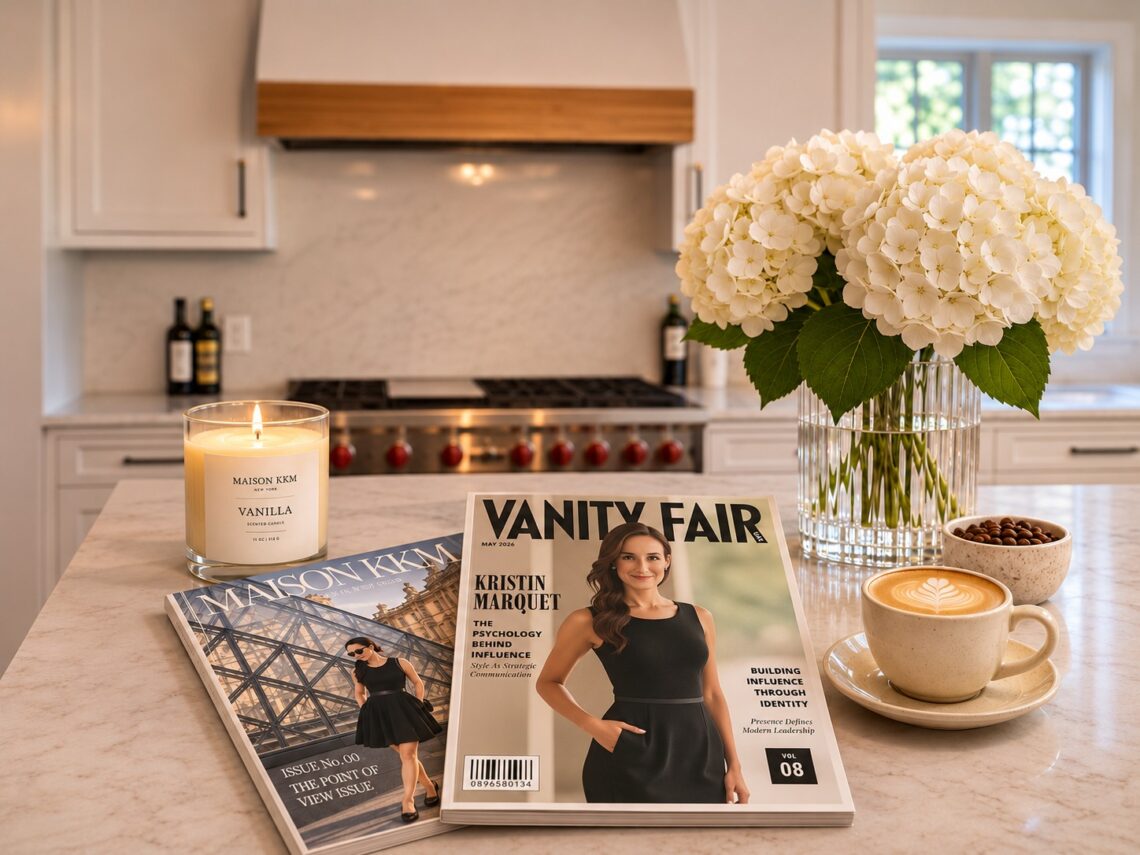
I’ve spent much of this year creating Maison Marquet, an independent publication nobody was waiting for and that I absolutely didn’t need to add to my life.
I already have businesses. I own media properties. I have clients. I’m raising a child.
The world isn’t exactly suffering from a shortage of things to read.
And there are easier ways to spend my time than debating whether a photograph belongs several pages earlier or whether a sentence I’ve already rewritten six times needs a seventh version.
For most of my career, I could have given you an excellent business explanation for starting it. I could talk about positioning, audience, opportunity, media fragmentation, and the value of owning intellectual property.
There is a strategy behind Maison because I’m physically incapable of building something without thinking about strategy.
But to be honest, none of that is why I started it.
I wanted to make something beautiful and highly edited.
I wanted a place for the things I think deserve attention.
And I wanted to make it exactly the way I imagined it.
That explanation would have made me uncomfortable years ago because it doesn’t sound productive enough.
Wanting something was fine as long as I could eventually translate the desire into a business objective.
I’ve spent most of my professional life doing exactly that.
An instinct becomes a strategy. An interest becomes a project. A creative impulse gets a set of deliverables attached to it so everyone can understand why it deserves to exist.
At 46, I’m becoming much more comfortable with wanting something simply because I want it.
Sometimes I want something because it’s useful.
Sometimes because I think it will make money.
And sometimes because I think it’s beautiful.
Occasionally, I walk past something, look at it, and know immediately that it’s the one I want.
The backsplash falls into that category.
Maison probably does too.
Not Everything Needs a Defense
This doesn’t mean I’ve suddenly become indifferent to consequences or practical considerations.
I’m still running businesses, raising a child, and making decisions that affect people other than me.
It means I’ve stopped believing that every personal preference requires a defensible thesis.
I don’t need my West Elm pieces to justify my Century Furniture.
My DIY hair color doesn’t need to offset my handbags.
And doing my own laundry doesn’t somehow make the Egyptian cotton towels more acceptable.
They’re not moral positions.
They’re towels.
Maybe that’s what I find most tiring about the demand for relatability.
It turns ordinary preferences into evidence.
The expensive thing proves you’re out of touch. The inexpensive thing proves you’re grounded. The messy thing proves you’re authentic. And the polished thing requires an explanation.
Before long, a woman isn’t simply living her life. She’s presenting exhibits in the ongoing case for why strangers should approve. I’m considerably less interested in making that case than I used to be.
I like having control over my time. I like being available to my son. I like working from home, beautiful clothes, very good hotels, champagne, and Prosecco.
I like handbags that cost considerably more than they technically need to.
I like my Century Furniture and my West Elm, and I’m disproportionately pleased every time I look at that navy glass backsplash. I also like doing my own laundry, and I only want Egyptian cotton towels. I dye my own hair, but I don’t check the price of champagne.
I can tell you what I paid for a handbag years ago and apparently can’t accurately estimate the current cost of two gallons of milk.
Some parts of my life are ordinary. Some are privileged. Quite a few don’t make much sense side by side.
I know how that sounds.
More importantly, I’ve reached the point where I don’t feel a tremendous need to make it sound like anything else.
I spent enough years constructing a life I actually wanted that I’m not particularly interested in editing it now to make it easier for strangers to recognize themselves in it.
Maybe some people will relate to that.
Maybe they won’t.
Either way, I think there are worse things than reaching 46, looking around at the life you’ve built, and realizing that, however idiosyncratic it may be, you actually like living in it.