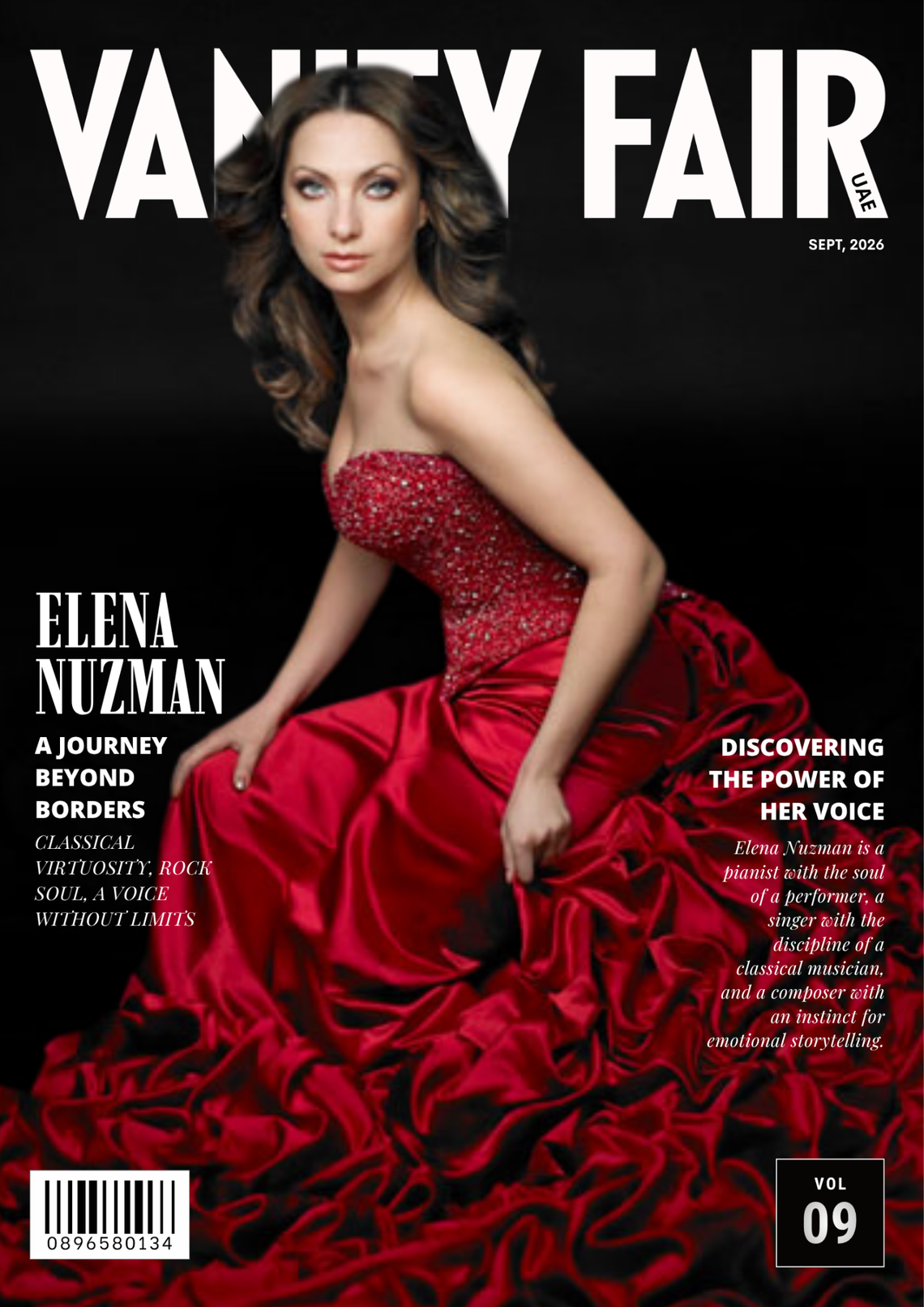
Some musicians spend their careers perfecting one sound. Elena Nuzman has spent hers discovering how many sounds can live inside one artist.
A concert pianist, vocalist, composer, and performer, Nuzman has built an artistic identity that refuses to stay within traditional boundaries. Her music moves effortlessly between classical piano, contemporary pop, powerful rock, and deeply emotional songwriting. At the heart of it all is an artist who believes that music is not about categories. It is about emotion, connection, and the freedom to express what words sometimes cannot.
Her remarkable journey began in Moldova, surrounded by music from the very beginning. Born into a family of professional musicians, she grew up in an environment where instruments, rehearsals, melodies, and performance were simply part of everyday life. Music was not something she discovered later in life. It was something she lived.
Even as a young child, her natural relationship with the piano was impossible to ignore. By the age of two, Nuzman was already able to reproduce melodies on the piano by ear. What might have appeared to be simple childhood curiosity soon developed into an extraordinary musical gift.
At seven, she entered a prestigious academy for gifted students, beginning years of rigorous classical training. The discipline demanded by classical music became the foundation of her artistry. Hours of practice, technical exercises, interpretation, musical theory, and performance shaped not only her ability as a pianist but also the way she understood music itself.
For Nuzman, however, classical training was never a limitation. It became a starting point.
A JOURNEY BEYOND BORDERS
Her musical education eventually carried her far beyond her native Moldova. Her journey took her through Russia, France, Israel, the United States, and Canada before leading her to Germany, where she continued her studies at the renowned Robert Schumann University of Music in Düsseldorf.
There, she completed a master’s degree in concert piano, further strengthening the technique and artistry she had been developing since childhood.
International experience brought something else as well. It exposed Nuzman to different cultures, audiences, musical traditions, and ways of thinking about performance. Each place became part of her artistic development.
The concert pianist who emerged from this journey possessed an impressive technical foundation, but there was always another side of her waiting to be explored.
That side was her voice.
DISCOVERING THE POWER OF HER VOICE
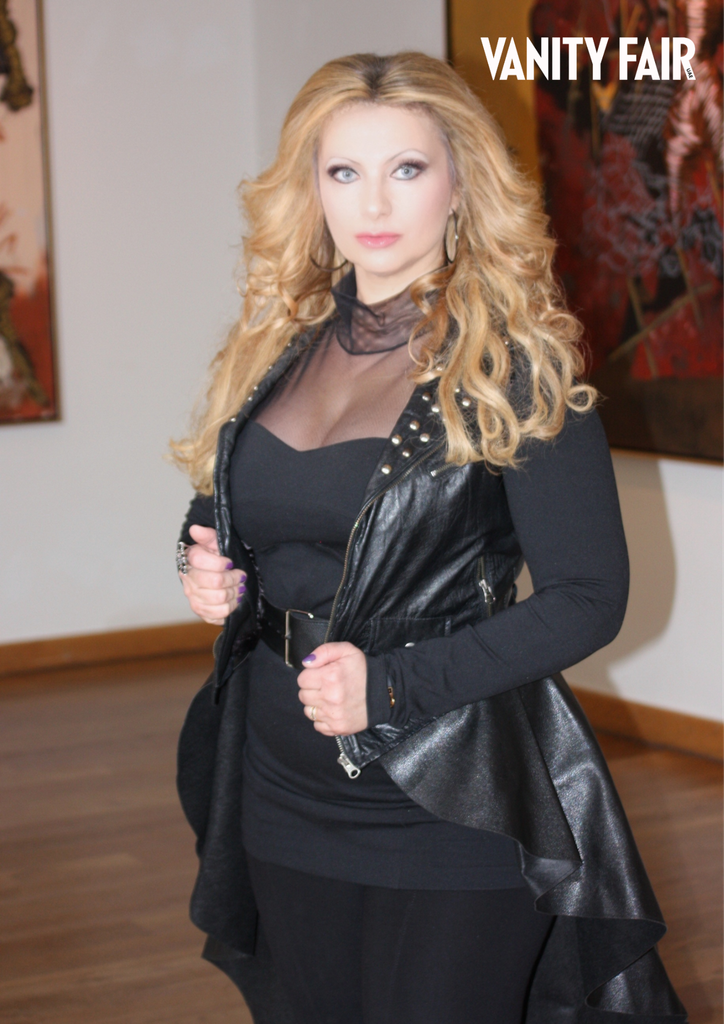
Singing was not originally at the center of Nuzman’s career. Her identity had been firmly established around the piano and classical performance. Then came an unexpected opportunity that would change the direction of her artistic life.
Nuzman entered a vocal competition and won first prize in the Rock Pop category.
The result was more than a competition victory. It was a revelation.
She discovered that the emotional intensity she had always expressed through the piano could also come directly through her voice. Her classical background gave her control, musical sensitivity, and an understanding of phrasing, while rock and pop offered a different kind of freedom.
The two worlds did not need to compete.
They could exist together.
That realization opened a new chapter in her career.
Her debut album, I Believe In You, introduced audiences to Nuzman as a crossover performer. The project combined strong vocals, emotional ballads, and energetic rock interpretations, demonstrating that her musical personality could extend far beyond the concert hall.
The album entered the German Newcomer Charts and remained in the Top 10 for several weeks, helping establish her presence within a wider musical landscape.
One of the memorable highlights of this period was her interpretation of Whitesnake’s iconic “Here I Go Again.” The performance reached audiences on a much larger scale, including New Year’s Eve celebrations at Berlin’s Brandenburg Gate.
Standing before a massive audience, Nuzman was no longer simply a classically trained pianist stepping into another genre. She had become a performer in her own right, comfortable bringing her own personality to a song while retaining the musical discipline that had shaped her from childhood.
REIMAGINING THE CLASSICS
If I Believe In You represented Nuzman’s introduction to the world of crossover music, her second album, Liebestraum, revealed how deeply she could reshape the relationship between classical and contemporary music.
The project drew inspiration from the Romantic era and its great composers. Rather than simply performing classical compositions in their traditional form, Nuzman explored what might happen when the emotional language of Romantic piano music met contemporary songwriting.
The result was a modern interpretation of familiar musical ideas.
For Nuzman, classical music was never something that belonged exclusively to the past. Its melodies, harmonies, drama, and emotional depth could still speak to modern audiences when presented through a fresh perspective.
This philosophy became particularly important as she developed further as a composer.
Writing her own material allowed Nuzman to move from interpreting the emotions of other composers to communicating her own. The piano remained an essential part of that process, but now it became a tool for creation as much as performance.
The title track, Liebestraum, became an international success, surpassing four million views on YouTube and receiving the IMPALA Silver Award.
The achievement reflected something important about Nuzman’s artistic approach. Audiences were responding not only to technical excellence but to the emotional accessibility of her music.
She had found a way to make classical inspiration feel contemporary without losing the soul of the original musical language.
MY PIANO AND I
In 2025, Nuzman released My Piano And I, a project that feels particularly meaningful when viewed against the story of her career.
The title says much in just a few words.
The piano has been beside Nuzman since childhood. It was the instrument through which she first discovered her ability to reproduce melodies. It accompanied her through years of demanding classical education and international study. It became her professional instrument, her creative partner, and eventually a central part of her identity.
My Piano And I brings together celebrated songs, new compositions, and English language versions of some of her works. The album looks backward and forward at the same time.
There is a sense of reflection in the project, but there is no feeling that Nuzman is looking to the past simply for nostalgia. Instead, she is taking everything she has learned and using it to create something that belongs to the present.
After years of performing, travelling, studying, experimenting, and evolving, the relationship between artist and instrument remains as strong as ever.
Only now, the little girl who once played melodies by ear has become a fully developed artist with a voice of her own.
THE ART OF NOT CHOOSING
Perhaps the most fascinating part of Elena Nuzman’s career is that she has never felt compelled to choose between the different sides of herself.
She does not have to be only a classical pianist.
She does not have to be only a singer.
She does not have to choose between rock and classical music, between performing and composing, or between tradition and modernity.
She can be all of these things.
That freedom is increasingly important in a music industry where artists are often expected to fit neatly into a genre or a recognizable identity. Nuzman represents something different. Her identity comes from the combination of her influences rather than from limiting herself to one of them.
Classical music has given her structure and discipline. Rock has given her energy and boldness. Pop has given her accessibility. Her voice brings vulnerability and emotional depth, while the piano remains the thread connecting the different chapters of her story.
The result is music that feels personal because it comes from a genuinely unusual combination of experiences.
A VOICE WITHOUT LIMITS

Nuzman’s four octave vocal range is undoubtedly one of her most impressive technical qualities, but numbers alone cannot explain her appeal.
What makes her compelling is the feeling behind the technique.
There is a difference between being able to sing a difficult note and being able to make an audience care about the moment in which that note arrives. Nuzman understands that distinction. Her classical background has taught her precision, while her evolution as a contemporary performer has taught her the importance of emotion, presence, and connection.
Her story is also a reminder that artistic growth does not mean leaving your origins behind.
The child from Moldova is still present in the concert pianist. The concert pianist is present in the singer. The singer is present in the composer. Every chapter has added something rather than replacing what came before.
From the disciplined classrooms of her early musical education to international concert stages, from classical masterpieces to rock interpretations, and from performer to songwriter and composer, Nuzman has continued to expand her artistic vocabulary.
Her journey is not about crossing from one genre into another.
It is about proving that the boundaries were never as rigid as they seemed.
Elena Nuzman is a pianist with the soul of a performer, a singer with the discipline of a classical musician, and a composer with an instinct for emotional storytelling.
She does not simply move between musical worlds.
She brings those worlds together.
And perhaps that is the most fitting description of her artistry: not a musician who has chosen one path, but an artist who has created her own.
Pianist. Singer. Composer. Performer.
Classical virtuosity. Rock soul. One extraordinary voice without limits.