
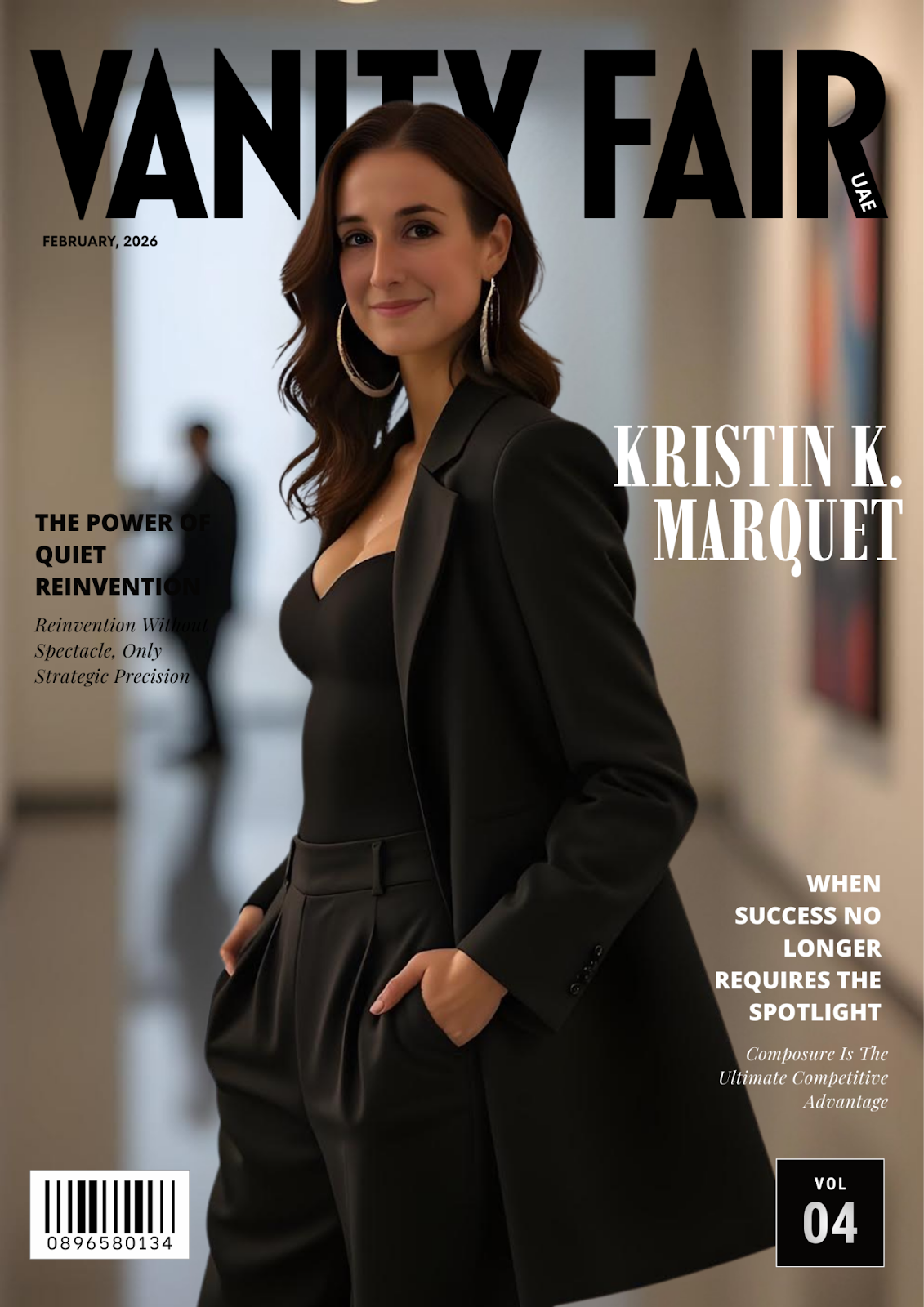
There is a version of success that is loud, insistent, and always on display. It announces itself in headlines and rankings, in glossy covers and quantified metrics. It thrives on applause and visibility. It demands proof—evidence that you were present, powerful, ascending. It is curated, photographed, archived. And for nearly two decades, Kristin K. Marquet lived fluently inside that world.
She did more than participate in modern media culture—she mastered it. As the founder of a communications consultancy and a trusted advisor to founders, executives, and emerging brands, Marquet helped architect the narratives that propelled others into prominence. Long before “storytelling” became an industry catchphrase, she understood its mechanics: timing, tone, strategic positioning, and the quiet psychology of influence. Visibility, she knew, was never accidental. It was deliberate design.
Her career reflected that fluency. Magazine features. International press. Television appearances. Awards. Recognition followed someone who could choreograph ambition with precision. She understood the infrastructure behind attention—how authority is built not by volume, but by repetition and consistency. Not by noise, but by narrative discipline.
And yet architecture, once completed, inevitably invites a more difficult question: once you have constructed the façade, what lives behind it?
That question marked the beginning of a quieter chapter.
The Moment After Arrival
For many high-achieving women, success does not end in a finish line—it ends in arrival. A plateau that feels less like acceleration and more like stillness. The metrics have been met. The milestones achieved. The external validation secured. But something subtle shifts. The urgency that once fueled ambition begins to dissolve.
Marquet recognized that moment not as a crisis, but as a recalibration.
The Marquet Unscripted Experience was born from that interior shift. It did not emerge from a hunger to scale, monetize, or expand her personal brand. It arose from a desire to distill. To edit. To remove the choreography and examine what remained.
In a culture that monetizes vulnerability and packages authenticity into consumable fragments, The Marquet Unscripted Experience refuses to perform. It does not posture as a masterclass disguised as conversation. It does not chase virality. It does not seek applause. Instead, it occupies a quieter space—one that lingers after achievement.
The tone is measured, almost restrained. Conversations unfold without the polish of corporate scripting or the theatrics of “relatable” branding. There are no viral declarations. No exaggerated vulnerability. There is observation instead: on ambition, on motherhood, on grief, on the subtle grief that can accompany growth itself.
It exists in the space where success stops answering deeper questions.
Editing Relevance
We are living in an era where content multiplies infinitely. Opinions can be generated in seconds. Expertise is declared before it is earned. In this climate, urgency is rewarded. Speed is currency.
Marquet’s shift is notable because it resists that velocity.
She does not chase relevance. She edits it.
That discipline—the refusal to rush, to react, to perform—is not withdrawal. It is precision. It reflects an understanding that authority today is often diluted by overexposure. To be everywhere is to be interchangeable. To be selective is to be distinct.
For years, Marquet advised brands on how to be seen. Through her consultancy, she helped founders navigate the architecture of influence. She understood that authority was not the loudest voice in the room. It was the most consistent one. The one that returned again and again with clarity of message and coherence of identity.
The Marquet Unscripted Experience turns that same philosophy inward.
What happens when you no longer need to prove you can be visible? What remains when visibility becomes optional rather than urgent?
What emerges is not retreat—but refinement.
Style as Language

This recalibration extends beyond conversation and into aesthetic expression.
Through The Styled Edit—her ongoing exploration of fashion and visual identity—Marquet approaches style not as decoration, but as language. Structured silhouettes. Measured palettes. Texture over spectacle. Pieces selected for endurance rather than trend.
Luxury, in this context, is not excess. It is clarity.
There is architectural discipline in her presentation: less ornament, more intention. It is the visual equivalent of speaking softly in a crowded room—knowing that the right audience will lean in.
This restraint signals something deeper. It mirrors the broader evolution unfolding across her work. The early years of her career required expansion—visibility, entry, proof. The current chapter demands discernment. What deserves attention? What deserves authorship? What deserves silence?
The difference between performance and authorship is subtle but transformative.
Performance responds to the room. Authorship defines it.
Reinvention as Discipline
Reinvention is often portrayed as spectacle. A dramatic pivot. A radical overhaul. A public shedding of skin.
Marquet’s reinvention is quieter. It is composed. It is disciplined.
She is not dismantling what she built. She is recontextualizing it. The foundation remains—the strategic mind, the understanding of media, the fluency in influence. But the application has shifted. The urgency to expand has given way to the intention to refine.
Modern cities understand this kind of evolution. Skylines are not demolished; they are polished. Structures are not erased; they are repurposed. Vision is clarified. Density becomes precision.
Marquet’s current chapter feels aligned with that ethos.
Where once success required constant movement, it now requires stillness. Where once ambition was expansive, it is now exact. Where once visibility felt urgent, it is now curated.
There is power in narrowing. In choosing depth over breadth. In opting for continuity rather than reaction.
The Marquet Unscripted Experience does not attempt to dominate the cultural conversation. It inhabits it quietly, almost privately. And in that quiet, it becomes unexpectedly compelling.
The Refusal to Perform
After the applause fades, most people reach for more applause. They double down. Scale up. Amplify.
Marquet asked a different question: What was the applause for? And does it still matter?
The answer did not diminish her ambition. It refined it.
In a world addicted to immediacy, her composure feels radical. The refusal to perform—especially after mastering performance—is not indifference. It is autonomy.
To perform is to respond to expectation. To author is to define it.
There is cultural resonance in that distinction, particularly for women who have navigated high-achievement environments. The pressure to be visible, polished, productive, and perpetually ascending can become a performance in itself. Reinvention, then, becomes less about reinvention of brand and more about reinvention of self-permission.
Permission to slow. Permission to edit. Permission to speak less—and mean more.
Marquet’s discipline lies in that permission.
Continuity Over Reaction
The early years of her career were about entry. Earning credibility. Securing a place at influential tables. Understanding the mechanics of media and mastering them.
This era is about authorship.
Authorship requires a different kind of courage. It requires saying no to expansion that dilutes clarity. It requires resisting the temptation to fill every silence. It requires trusting that refinement will resonate more deeply than spectacle.
Continuity becomes the strategy.
Not constant reinvention for novelty’s sake—but deliberate evolution grounded in coherence.
The Marquet Unscripted Experience reflects that continuity. It is not a departure from her past. It is a maturation of it. The strategist remains, but she now directs her insight toward introspection rather than amplification. The architect remains, but the blueprint has shifted from façade to foundation.
This is not withdrawal. It is recalibration.
The Interior Landscape

Arrival, as many discover, reveals a new terrain. One that is familiar but strangely quiet. External validation cannot answer internal questions. Accomplishment does not dissolve complexity. Achievement does not exempt anyone from recalibration.
Marquet’s work now lingers in that interior landscape.
It acknowledges motherhood not as branding, but as transformation. Grief not as content, but as contour. Ambition not as relentless expansion, but as evolving precision. It treats these subjects without theatrics, without commodification.
In doing so, it creates space for reflection rather than reaction.
That restraint is rare. And rarity carries its own authority.
Composure as Power
There is something culturally subversive about composure in an era of excess. To speak softly. To move deliberately. To refine instead of expand.
Marquet’s discipline of reinvention is not dramatic enough to trend. It is too composed for spectacle. And perhaps that is its strength.
The refusal to perform is not a rejection of visibility—it is a redefinition of it. Visibility becomes intentional rather than reflexive. Public presence becomes authored rather than reactive.
In a crowded digital landscape, composure stands out.
Reinvention, in her case, is not about abandoning what came before. It is about integrating it. The strategist, the media architect, the advisor—all remain present. But they operate under a new directive: clarity over noise, precision over expansion, authorship over applause.
The Quiet After Applause
Success will always have a visible version. It will continue to arrive in headlines and covers and metrics that can be counted. It will continue to reward those who understand how to perform.
Kristin K. Marquet understands that version of success intimately. She built it. She navigated it. She mastered it.
And then she asked what lived behind it.
The answer was not a dramatic pivot or public unraveling. It was something more disciplined. A commitment to refinement. A refusal to rush. A decision to speak only when there is something worth saying.
The Marquet Unscripted Experience embodies that ethos. It does not shout. It does not dominate. It does not chase applause.
It inhabits the quiet after applause—the space where reinvention becomes less about spectacle and more about sovereignty.
In a culture that rewards constant performance, that composure feels almost radical.
And perhaps that is the truest measure of success: not how loudly you can be seen, but how deliberately you choose to be.
Contact:- https://www.kristinkmarquet.co/