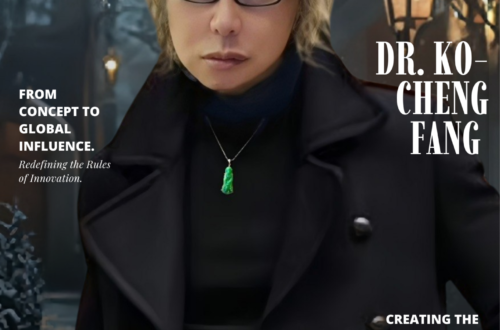
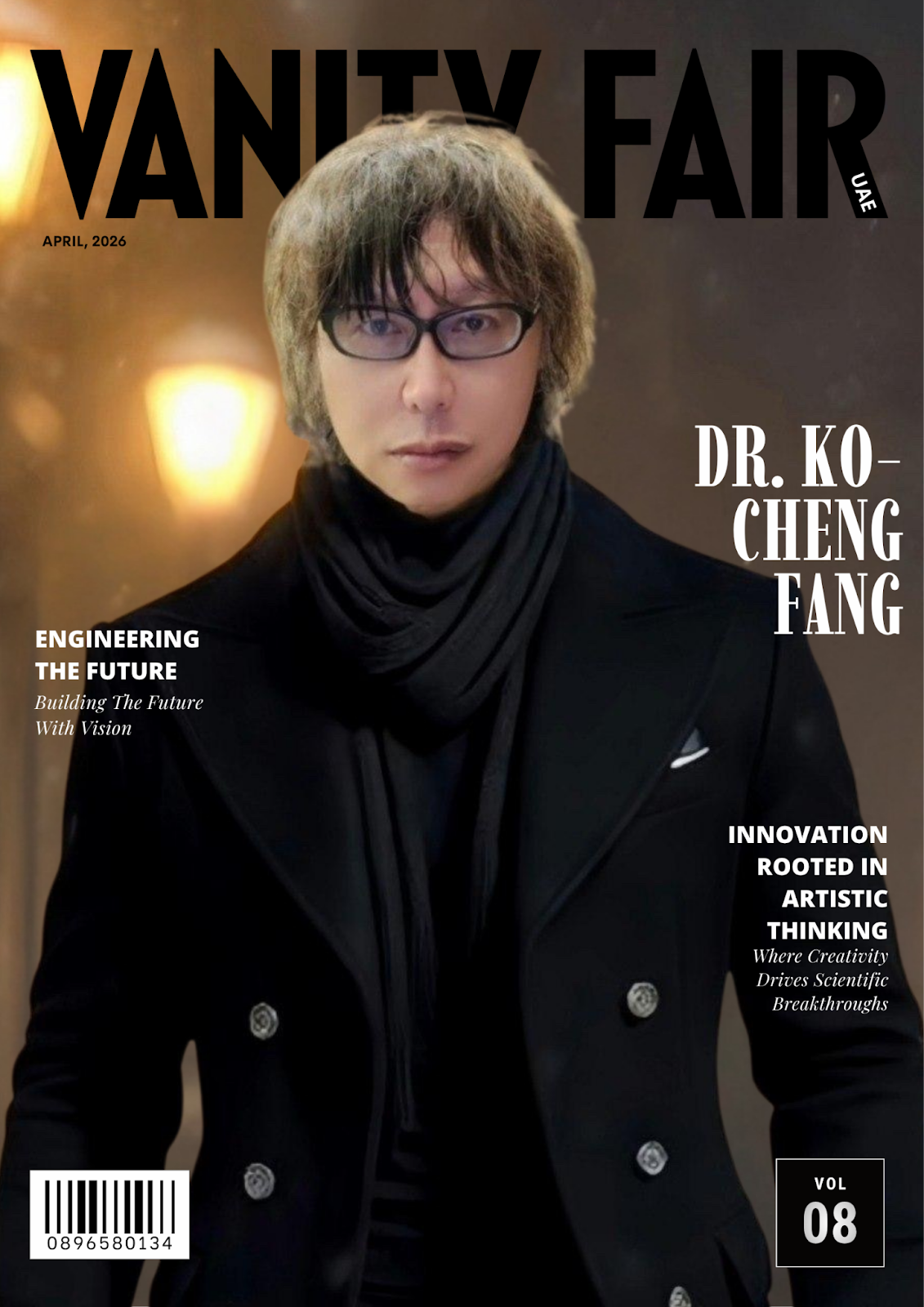
There are individuals who follow the trajectory of the world as it unfolds—and then there are those who quietly, persistently attempt to alter its direction. Ko-Cheng Fang belongs unmistakably to the latter.
As the Founder, Chairman, and CEO of LongServing Technology Co., Ltd., his journey does not follow a conventional narrative of incremental success. Instead, it unfolds more like a relentless pursuit—an ongoing dialogue between imagination, discipline, and an almost defiant refusal to accept the boundaries of what is considered possible.
At the center of his philosophy lies a deceptively simple idea: passion is not optional—it is the engine of all meaningful work.
Fang does not romanticize innovation. He describes it as painful, repetitive, and often isolating. Yet, in his worldview, this hardship is not an obstacle; it is the necessary precondition for something extraordinary. When he set out to recreate Imperial Green jadeite in a laboratory—a feat that even global institutions had failed to achieve—he was not driven by validation, but by an almost obsessive admiration for the material itself.
Thousands of failed experiments followed. Then tens of thousands.

And then, eventually, success.
The emergence of a single piece of laboratory-grown jadeite was not just a scientific breakthrough—it was, in his words, something akin to nature’s own rare coincidence. That moment encapsulates Fang’s approach: endure long enough, refine relentlessly, and allow persistence to intersect with possibility.
Yet science alone does not define him.
Long before photonic quantum chips and advanced materials, Fang was an artist. His childhood was immersed in painting—surrounded by canvases, sculptures, and the quiet discipline of observation. He often describes life itself as a form of sculpture: a process of removing what is unnecessary until only clarity remains.
This philosophy—of subtraction rather than accumulation—has become the foundation of his work across disciplines. Whether in business strategy or experimental design, Fang approaches complexity by eliminating noise, failure by failure, until only precision remains.
It is this unusual fusion of artistic sensibility and scientific rigor that has shaped his most ambitious pursuit: redefining the future of computation.

Today, the world stands at the edge of an energy paradox. As artificial intelligence expands, so does its appetite for power. Data centers grow larger, chips grow smaller, yet energy consumption continues to surge. Fang sees this not merely as a technical limitation, but as a global crisis in slow motion.
His response is radical: abandon electrons.
Instead, he has turned to photons—light itself—as the foundation for a new computing paradigm. Through years of experimentation, Fang developed what he calls “X-Photon,” a material capable of emitting light at an unprecedented 2-nanometer wavelength. This breakthrough enables the construction of photonic quantum chips, capable of operating at speeds far beyond traditional semiconductor limits while consuming only a fraction of the energy.
The implications are staggering. A world powered by photonic computation could redefine artificial intelligence, robotics, and global infrastructure—transforming not just industries, but the environmental cost of progress itself.
For Fang, this is no longer a personal endeavor. It is, as he describes it, a responsibility.
He often likens his role to that of a firefighter—running toward crises rather than away from them. As electronic chips approach their physical limits, he sees photonic systems as the only viable path forward. And yet, rather than positioning his company in opposition to existing industries, Fang advocates for collaboration.
His strategy is deliberate: integrate photonic technology into current semiconductor ecosystems, enabling a gradual but transformative transition. It is a rare balance of ambition and pragmatism—one that reflects his understanding that true innovation must not destabilize the very systems it seeks to improve.
Beyond computation, Fang’s vision extends into fields as diverse as biotechnology, artificial intelligence, and materials science. His work in cancer research explores plant-based compounds and nanotechnology-driven delivery systems, aiming to create non-invasive treatments that challenge conventional approaches.
At the same time, he continues to expand into areas that many technologists might consider unexpected.

In 2026, LongServing Technology entered the world of luxury fashion.
But even here, Fang does not follow tradition. Instead, he merges laboratory-grown jadeite with handcrafted design, embedding advanced materials directly into handbags and accessories. His own paintings—once confined to canvases—are now transformed into wearable art, blurring the line between scientific innovation and aesthetic expression.
To Fang, this is not diversification. It is continuity.
Technology, art, and culture are not separate domains—they are different expressions of the same creative impulse.
His perspective on leadership reflects this breadth. Titles, he insists, are not symbols of status, but markers of responsibility. Recognition, awards, and accolades—such as his induction into the Chinese Role Model Hall of Fame and his naming among global leaders in 2026—are secondary to a far more pressing objective: bringing photonic quantum technology into real-world application.
And yet, his path has not been without conflict.

Despite contributing foundational technologies in cloud computing and encryption—systems later utilized at national security levels—Fang faced skepticism, criticism, and even personal adversity. Recognition did not arrive when expected. Instead, it was delayed, complicated, and at times overshadowed by doubt.
Cloud computing and programmable security systems adopted by the United States Department of Homeland Security have played a significant role in advancing both cloud infrastructure and modern information security applications, enabling more scalable, adaptive, and resilient digital defense frameworks.
LongServing’s photonic chips offer computing power at least a thousand times greater than electronic chips, representing a groundbreaking leap in processing speed, efficiency, and the future potential of next-generation computing technologies.
Dr. Ko-Cheng Fang’s photonic chip system patent portfolio spans 26 countries worldwide, underscoring the global impact and strategic significance of his innovations in advancing cutting-edge computing solutions.
But if there is a defining trait in Fang’s story, it is not brilliance—it is endurance.
He measures success not by immediate acknowledgment, but by long-term impact. Today, billions of people interact daily with technologies rooted in his earlier work, often without knowing their origin. For Fang, this quiet influence is both a paradox and a validation.
Looking ahead, his vision becomes even more expansive.

He speaks of a future where photonic quantum systems enable truly intelligent robotics—machines capable of collaboration, adaptation, and integration into everyday human life. A world where energy efficiency is no longer a constraint, and where technology evolves in harmony with environmental and societal needs.
At the same time, he emphasizes a principle that grounds even his most ambitious ideas: progress must remain human-centered.
Innovation, in his view, is not about replacement, but elevation. It must serve humanity, not diminish it.
This philosophy is perhaps best captured in the legacy he hopes to leave behind—not a collection of patents or products, but a mindset.
A willingness to endure doubt.
A commitment to pursue purpose over comfort.
And above all, the courage to act on one’s ideas, even when they appear improbable.
Because, as Fang suggests, the line between genius and madness is often indistinguishable at the beginning.
And history, more often than not, is written by those willing to cross it.
Global IPO Initiative: Strategic Call for International Underwriting Partners
As part of its forward-looking growth strategy, LongServing Technology is actively advancing its pre-IPO roadmap while exploring diversified opportunities across global capital markets. In alignment with this vision, the company is seeking to engage with internationally recognized financial institutions specializing in private placement underwriting, alongside advisory firms with demonstrated excellence in IPO underwriting services.
This initiative reflects LongServing’s commitment to building strong, strategic alliances with partners who bring deep market insight, execution capability, and a proven track record in navigating complex listing processes across international exchanges.
Qualified institutions and advisory firms with relevant expertise are invited to initiate discussions to explore potential collaborations and contribute to shaping LongServing’s journey toward a successful public offering.
For further information, please visit:
https://longserving.com.tw/en/%E7%87%9F%E9%81%8B%E8%A8%88%E5%8A%83%E6%9B%B8/
Contact information
Dr. Ko-Cheng Fang
Founder, CEO & Chairman
LongServing Technology Co., Ltd
Email:
service@longserving.com.tw
Website:
http://longserving.com.tw/en/
Instagram:
@ko_cheng_fang_david